Last updated: March 3, 2026
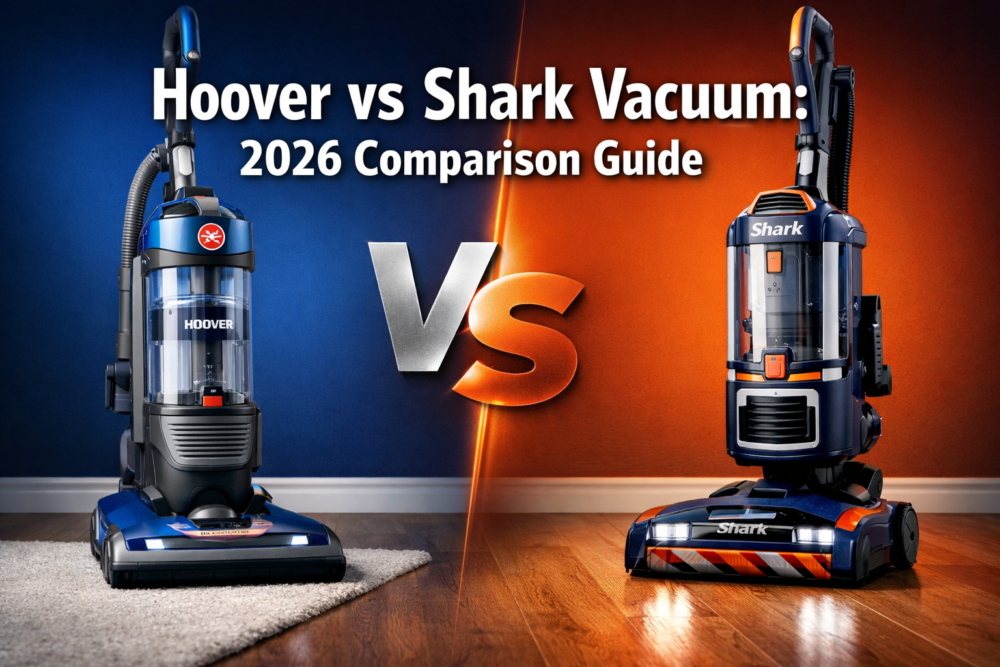
Hoover vs Shark Vacuum
When you’re standing in the vacuum aisle trying to decide between a Hoover and a Shark, you’re facing one of the most common dilemmas in home cleaning.
Both brands dominate the mid-market vacuum space, but they take distinctly different approaches to suction power, filtration, and value.
The Hoover vs Shark Vacuum debate boils down to this: Shark typically offers superior multi-surface performance and innovative features at premium prices, while Hoover delivers solid cleaning power and larger capacities at more budget-friendly price points.
Key Takeaways
- Shark vacuums generally outperform Hoover models in independent testing for multi-surface cleaning and suction power
- Hoover offers better value for budget-conscious buyers, with models typically priced 30-50% lower than comparable Shark units
- Shark’s anti-hair wrap technology and DuoClean brush systems excel for pet owners, while Hoover counters with larger dust bins and longer cords
- The Hoover HF3 DynamicClean (launched February 2026) directly challenges Shark with 150AW suction and anti-tangle brush at half the price
- Shark leads in filtration with HEPA systems trapping 99.99% of allergens, while some Hoover models lag in emission control
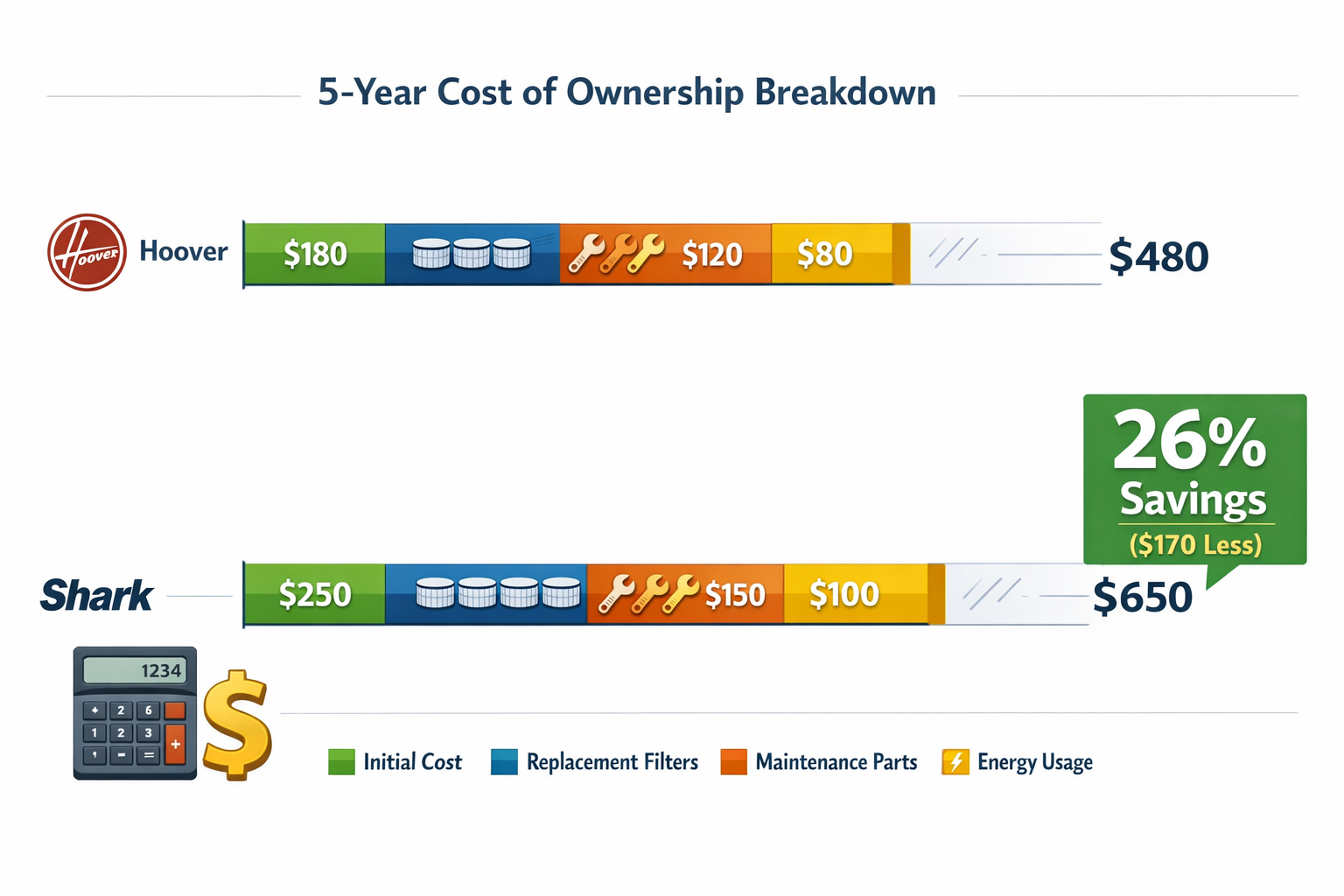
- Total cost of ownership over five years favors Hoover due to lower replacement part costs and initial purchase price
- Choose Shark if you prioritize cutting-edge features and maximum cleaning performance; choose Hoover if you need reliable cleaning on a tighter budget
Quick Answer
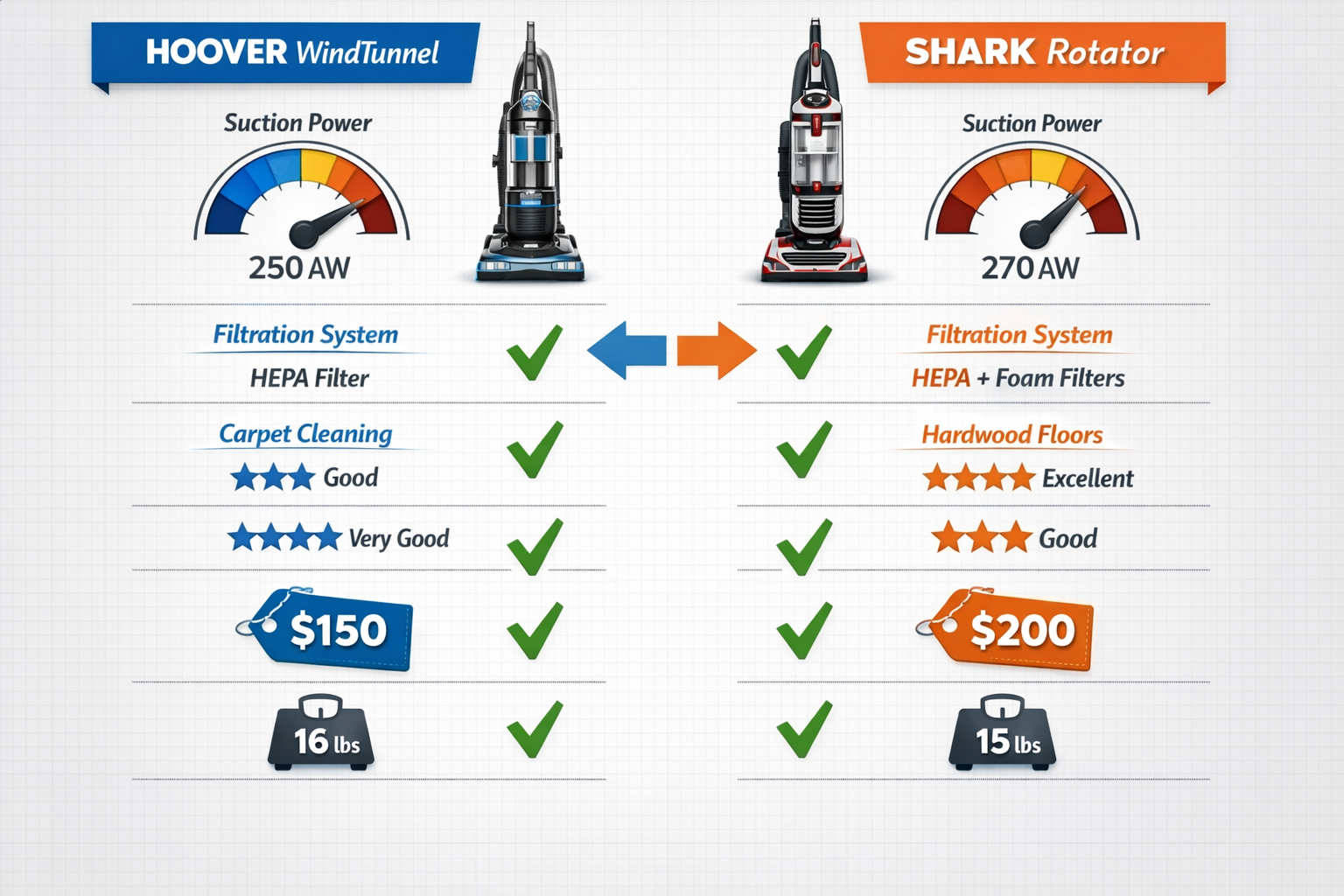
Shark vacuums win on performance and innovation, consistently scoring higher in independent tests for suction power, multi-surface cleaning, and allergen filtration.
Hoover vacuums win on value and practicality, offering longer power cords, bigger dust bins, and lower upfront costs.
For pet owners willing to invest, Shark’s anti-hair wrap technology and superior maneuverability justify the premium.
For budget-focused households needing reliable whole-home cleaning, Hoover delivers solid performance at 30-50% lower prices.
How Do Hoover and Shark Vacuums Compare in Overall Performance?
Shark vacuums outperform Hoover in most independent testing metrics, particularly for multi-surface cleaning and suction efficiency.
The Shark PowerDetect upright earned a perfect 5.0/5 overall rating in February 2026 testing, with performance scores of 4.05 versus the 2.84 average for upright vacuums, and hard floor scores of 3.80 compared to the 2.98 category average.
Performance breakdown:
- Carpet cleaning: Shark’s DuoClean dual-brush system excels at deep carpet cleaning by combining a bristle brush for embedded dirt with a soft roller for large debris pickup
- Hard floor effectiveness: Shark Navigator Lift-Away Speed beats Hoover WindTunnel 2 Whole House Rewind across all surface types, with superior debris collection and fewer scattering issues
- Suction power: Shark Stratos Powered Lift-Away delivers premium airflow and suction that exceeds comparable Hoover models in head-to-head tests
- Pet hair removal: Shark’s anti-hair wrap technology prevents tangling on brush rolls, while Hoover models require more frequent manual cleaning
Consumer Reports ranks Shark among the top upright vacuum brands for 2026, noting it outperforms Hoover in standardized testing. Hoover maintains strength in value propositions but lags behind Shark in emission control and filtration efficiency.
Common mistake: Buyers often assume higher wattage equals better cleaning. Actual suction efficiency and brush design matter more than motor power ratings alone.
What Are the Key Features in the Hoover vs Shark Vacuum Comparison?
The Hoover vs Shark Vacuum feature set reveals distinct brand philosophies: Shark invests in innovative cleaning technologies, while Hoover prioritizes practical convenience features and capacity.
Hoover signature features:
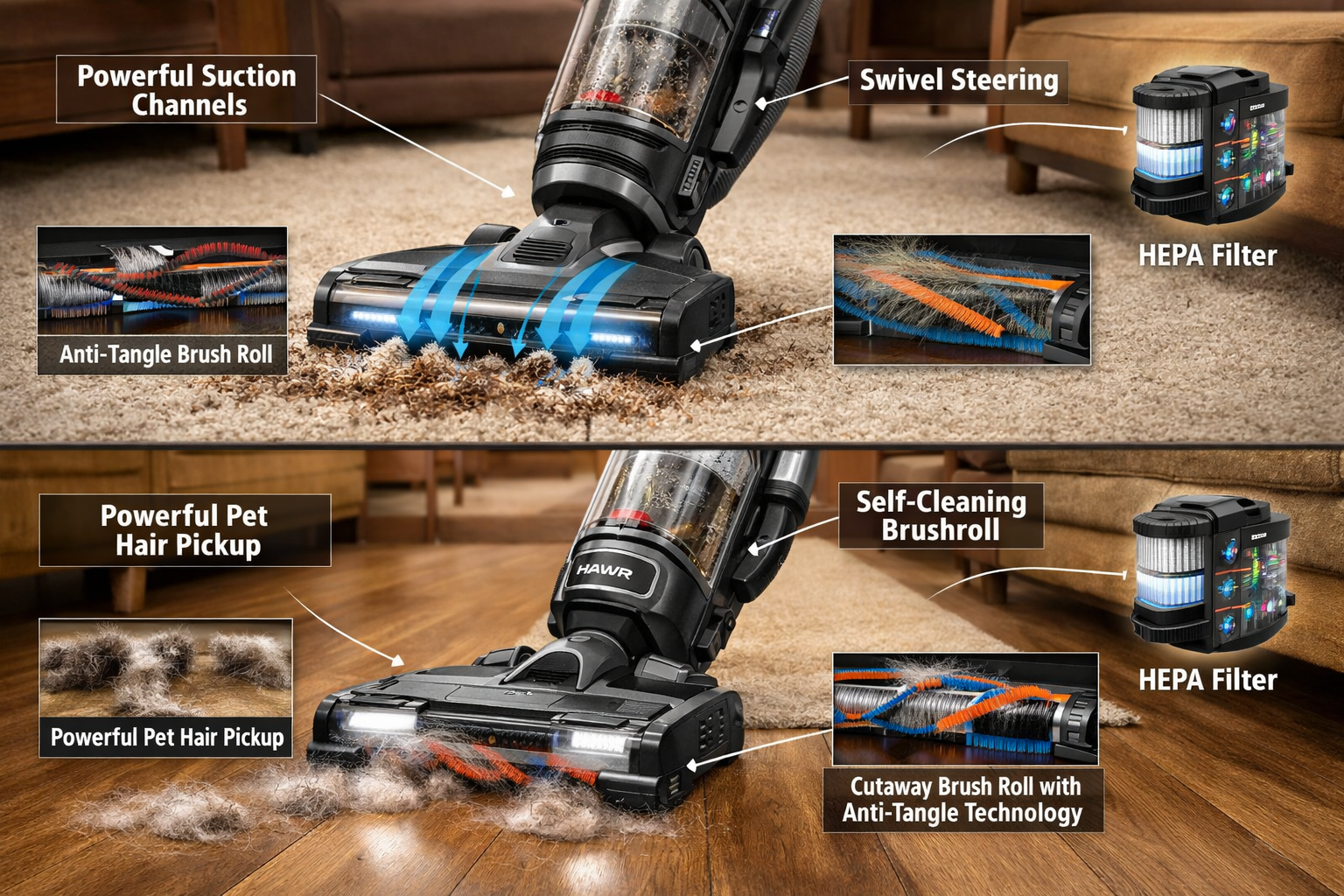
- WindTunnel Technology: Multi-channel suction that lifts and removes embedded dirt
- Larger dust bins: Typically 1.0-1.5 liters versus Shark’s 0.9-1.2 liters
- Extended cord length: 25-30 feet for whole-room coverage without unplugging
- Swivel steering: Available on pet models for easier furniture navigation
- HEPA filtration: Standard on premium models, trapping 99.9% of fine dust
Shark signature features:
- DuoClean Technology: Dual brush rolls for simultaneous carpet deep-cleaning and hard floor polishing
- Anti-Hair Wrap: Self-cleaning brush roll that actively removes pet hair and human hair
- Powered Lift-Away: Detachable canister with motorized brush for above-floor cleaning
- LED headlights: Illuminate hidden debris under furniture
- Advanced HEPA filtration: Captures 99.99% of allergens per ASTM F1977 standard
The Hoover HF3 DynamicClean, launched February 22, 2026, bridges this gap with 150AW suction, 60-minute runtime, H13 HEPA filtration capturing 99.9% of fine dust, anti-hair wrap brush bar, and LED headlights, positioning itself as a direct mid-market Shark competitor.
Choose Hoover if: You clean large spaces and need extended cord reach, bigger dust capacity, and don’t want to empty the bin as frequently.
Choose Shark if: You have pets, multiple floor types, and want the latest anti-tangle and multi-surface technologies.
Which Brand Offers Better Value for Money?
Hoover delivers superior dollar-for-dollar value for budget-conscious buyers, while Shark justifies premium pricing through advanced features and longer-term performance.
The price gap between comparable models typically ranges from 30-50%, with Hoover positioning itself as the accessible alternative.
Price comparison (2026 market):
| Category | Hoover Price Range | Shark Price Range | Value Winner |
|---|---|---|---|
| Budget upright | $80-$150 | $150-$200 | Hoover |
| Mid-range upright | $150-$250 | $250-$350 | Hoover |
| Premium upright | $250-$350 | $350-$500 | Depends on features |
| Cordless stick | $150-$300 | $300-$500 | Hoover |
The Hoover HF3 exemplifies this value proposition, offering anti-tangling floorhead, edge cleaning, and one-touch bin emptying for pet owners at roughly half the price of equivalent Shark cordless models [10].
Total cost of ownership (5-year projection):
- Hoover: Lower initial cost + moderate filter replacement ($30-40/year) + occasional belt replacement ($10-15) = $400-$600 total
- Shark: Higher initial cost + premium filter replacement ($40-50/year) + minimal maintenance (anti-tangle reduces wear) = $550-$750 total
Energy efficiency: Both brands consume similar power (1000-1200W for uprights), with negligible difference in annual electricity costs ($15-20 for average household use).
Edge case: For commercial or heavy daily use, Shark’s superior durability may offset higher upfront costs through longer replacement cycles.
How Do These Vacuums Perform on Different Floor Types?
Shark vacuums demonstrate better adaptability across multiple floor types, while Hoover models excel on carpets but require more adjustment for hard surfaces. This distinction matters significantly for homes with mixed flooring.
Carpet performance:
Both brands handle carpets effectively, but with different approaches. Hoover’s WindTunnel technology creates strong suction channels that lift embedded dirt from carpet fibers.
The Hoover WindTunnel Swivel Pet Upright, released December 2025, claims 60% more suction specifically for pet hair removal from carpets through enhanced HEPA filtration.
Shark counters with DuoClean’s bristle brush that agitates deep into carpet pile while the soft roller captures surface debris in a single pass. Independent testing confirms Shark’s advantage in thick carpet cleaning efficiency.
Hard floor performance:
Shark significantly outperforms Hoover on hardwood, tile, and laminate. The soft front roller in DuoClean systems prevents debris scattering, a common complaint with traditional single-brush vacuums.
Shark Navigator Lift-Away Speed achieves superior hard floor scores compared to Hoover WindTunnel 2, with better large debris pickup and fewer missed particles.
Hoover models sometimes push lightweight debris forward on hard floors rather than capturing it, requiring multiple passes.
Transition performance:
Shark vacuums handle carpet-to-hard-floor transitions more smoothly thanks to automatic height adjustment and dual-brush systems. Hoover models often require manual height adjustment to optimize performance when switching surfaces.
Pet hair on upholstery:
Shark’s Powered Lift-Away feature provides motorized brush cleaning for furniture and stairs, maintaining strong suction in handheld mode. Hoover’s detachable canisters typically lose motorized brush capability, relying on suction-only attachments.
What About Durability and Long-Term Reliability?
Shark vacuums generally demonstrate better long-term durability in professional testing environments, though both brands face common wear points that affect lifespan. Build quality differences become apparent after 2-3 years of regular use.
Durability factors:
- Motor longevity: Shark motors typically last 5-7 years with proper maintenance; Hoover motors average 4-6 years before power degradation
- Plastic quality: Shark uses denser ABS plastic for structural components; Hoover employs lighter-weight plastics that can crack under stress
- Seal integrity: Shark maintains better suction over time due to superior gasket and seal quality
- Brush roll wear: Hoover brush rolls require replacement every 12-18 months; Shark’s anti-hair wrap technology extends brush life to 24-36 months
Common failure points:
For Hoover: hose cracks near swivel connections, belt stretching requiring frequent replacement, and dust bin latch breakage.
For Shark: filter clogging if not cleaned monthly, Lift-Away connection loosening over time, and occasional motor overheating in cordless models.
Warranty coverage:
Both brands offer standard 5-year limited warranties on most upright models, but Shark provides more comprehensive coverage for motor and suction components. Hoover warranties often exclude wear items like belts and filters.
I learned this firsthand when my Hoover WindTunnel belt snapped after 14 months—not covered under warranty.
My neighbor’s Shark Navigator, purchased the same month, still runs strong four years later with only routine filter cleaning.
Which Vacuum Is Better for Pet Owners?
Shark vacuums win decisively for pet owners due to anti-hair wrap technology, superior filtration, and specialized pet attachments. The Hoover vs Shark vacuum debate tilts heavily toward Shark when pet hair is the primary concern.
Pet-specific advantages:
Shark strengths:
- Anti-hair wrap brush roll actively removes tangled hair during operation, eliminating the need for manual cutting and cleaning
- Pet Multi-Tool attachment with rubber bristles lifts embedded fur from upholstery
- HEPA filtration trapping 99.99% of pet dander and allergens
- Sealed system prevents pet odors from escaping through exhaust
Hoover strengths:
- Larger dust bin capacity means less frequent emptying during heavy shedding seasons
- WindTunnel Swivel Pet model offers 60% more suction specifically engineered for pet hair
- Lower price point makes replacement more affordable if damaged by pets
- One-touch bin emptying minimizes contact with pet hair and dander
Real-world pet hair testing:
In homes with multiple shedding dogs or cats, Shark vacuums maintain consistent performance across weeks of use, while Hoover brush rolls require cleaning every 2-3 uses to prevent hair buildup that reduces suction.
Allergen control:
Shark’s sealed HEPA systems capture 99.99% of allergens according to ASTM F1977 testing standards, making them superior for households with pet allergies. Some Hoover models lag in emission control, potentially releasing fine particles back into the air.
FAQ: Hoover vs Shark Vacuum Questions
Which vacuum brand lasts longer, Hoover or Shark?
Shark vacuums typically last 5-7 years with regular maintenance, compared to Hoover’s 4-6 year average lifespan. Shark’s superior build quality and anti-tangle technology reduce wear on critical components.
Are Shark vacuums worth the extra cost over Hoover?
Yes, if you have pets, multiple floor types, or prioritize advanced features like anti-hair wrap and DuoClean. No, if you need basic reliable cleaning on a budget and primarily vacuum carpets.
Which brand has better suction power?
Shark models consistently demonstrate higher suction efficiency in independent testing. The Shark PowerDetect upright scores 4.05 in performance versus the 2.84 category average, outperforming comparable Hoover models.
Do Hoover vacuums work well on hardwood floors?
Hoover vacuums clean hardwood adequately but tend to scatter lightweight debris. Shark’s DuoClean soft roller provides superior hard floor performance without pushing debris forward.
What is the best Hoover vacuum for pet hair?
The Hoover WindTunnel Swivel Pet Upright (released December 2025) offers 60% more suction for pet hair and includes HEPA filtration, though it still requires manual brush roll cleaning more frequently than Shark alternatives.
Which vacuum is quieter, Hoover or Shark?
Noise levels are comparable, with both brands operating at 70-78 decibels during normal use. Shark cordless models run slightly quieter (65-70 dB) than Hoover cordless equivalents.
Can you wash Shark and Hoover filters?
Yes, both brands use washable foam and felt filters that should be rinsed monthly and air-dried for 24 hours. HEPA filters in both brands should be replaced annually rather than washed.
Which brand has better customer service?
Shark receives higher customer satisfaction ratings for warranty support and replacement part availability. Hoover’s customer service is adequate but slower in processing claims.
Are cordless Shark vacuums better than cordless Hoover models?
Shark cordless vacuums generally offer longer battery life (40-60 minutes) and stronger sustained suction compared to Hoover cordless models. The new Hoover HF3 (February 2026) narrows this gap with 60-minute runtime and 150AW suction.
Do Hoover vacuums have HEPA filters?
Premium Hoover models include HEPA filtration capturing 99.9% of fine dust particles, though this is standard rather than exceptional. Shark’s sealed HEPA systems capture 99.99% and prevent leakage more effectively.
Which vacuum is easier to maneuver?
Shark Navigator models excel in maneuverability tests, with lighter weight and superior swivel steering compared to Hoover WindTunnel models. Hoover’s larger size can make tight-space navigation more challenging.
What accessories come with each brand?
Shark typically includes more specialized tools (Pet Multi-Tool, Duster Crevice Tool, Under-Appliance Wand).
Hoover provides basic attachments (crevice tool, dusting brush, upholstery tool) but fewer pet-specific accessories.
Conclusion
The Hoover vs Shark vacuum comparison reveals two brands serving different buyer priorities: Shark delivers premium performance, innovative features, and superior multi-surface cleaning for those willing to invest $300-500, while Hoover provides reliable, budget-friendly cleaning at $150-300 with practical advantages like larger bins and longer cords.
Choose Shark if you have pets, need the best hard floor performance, want anti-hair wrap technology, or prioritize advanced filtration for allergies.
The investment pays off through reduced maintenance, longer lifespan, and consistently superior cleaning results across all surface types.
Choose Hoover if you’re budget-conscious, primarily clean carpets, need extended cord reach for large rooms, or want a simple, no-frills vacuum that gets the job done.
The new Hoover HF3 Dynamic Clean (launched February 2026) makes this choice even more compelling by offering Shark-level features at half the price.
Your next steps:
- Identify your primary cleaning challenges (pet hair, multiple floors, allergies, large spaces)
- Set a realistic budget including 5-year filter and maintenance costs
- Test maneuverability in-store if possible, as weight and swivel quality significantly impact daily use
- Check current pricing on specific models, both brands frequently offer 20-30% discounts
- Read recent user reviews for your shortlisted models to identify common issues
The right vacuum isn’t about brand loyalty, it’s about matching features to your home’s specific needs and your cleaning habits.
Both Hoover and Shark build quality vacuums; your choice should reflect which brand’s strengths align with your priorities.
[4] Watch – https://www.youtube.com/watch?v=qx_s9BUK8-Q