HEPA-14 & Medical-Grade Air Filtration
If you or someone you love wakes up every morning with a stuffy nose, itchy eyes, or persistent sneezing, HEPA-14 & Medical-Grade Air Filtration for allergy sufferers might be the most important investment you make this year.
Medical expenses for individuals sensitive to air pollutants can exceed $1,000 per year, which means a well-chosen, properly maintained HEPA-14 system can genuinely pay for itself through fewer doctor visits, reduced medication costs, and dramatically better quality of life.
Key Takeaways
| Question | Quick Answer |
|---|---|
| What is HEPA-14 filtration? | HEPA-14 (also called H14) is the highest commercially available HEPA standard, capturing 99.995% of particles at 0.3 microns, including most allergens, bacteria, and fine dust. |
| Is HEPA-14 the same as medical-grade filtration? | Not exactly, but HEPA-14 meets the threshold for medical-grade air purification. True medical-grade systems combine an H14 filter with a fully sealed housing to prevent air bypass. |
| Do HEPA-14 air purifiers really help with allergies? | Yes. Clinical evidence consistently shows that H14 filtration reduces airborne allergen concentrations including pollen, dust mites, pet dander, and mould spores, leading to fewer allergy symptoms. |
| How often should I replace a HEPA-14 filter? | Every 6 to 12 months for most home units, though heavy use or high-pollution environments may require more frequent replacement. Never wait until airflow drops noticeably. |
| What room size suits a HEPA-14 unit? | Match the unit’s CADR (Clean Air Delivery Rate) to your room size. For bedrooms, aim for 2-3 air changes per hour; for larger living spaces, choose units rated for at least 500 sq ft. |
| Does vacuuming complement HEPA-14 air filtration? | Absolutely. A HEPA-14 air purifier catches airborne particles, but regular vacuuming tackles settled allergens in carpets and upholstery. The two work together for total allergen management. Check our home cleaning reviews for vacuum options. |
| What is the biggest mistake allergy sufferers make with air purifiers? | Neglecting filter replacements. A clogged or degraded HEPA-14 filter can lose more than half its allergen removal efficiency, making the unit almost useless against airborne triggers. |
Check Prices and Availability at Amazon
What Is HEPA-14 & Medical-Grade Air Filtration for Allergy Sufferers?
HEPA stands for High-Efficiency Particulate Air, and the number that follows tells you exactly how efficient the filter is.
While standard HEPA (H13) captures 99.97% of particles at the most penetrating particle size of 0.3 microns, HEPA-14 (H14) captures 99.995%, making it roughly 20 times more efficient at trapping the finest particles.
For allergy sufferers, that difference is not just a number on a spec sheet. It translates into a dramatically cleaner breathing environment, particularly for those dealing with asthma, hay fever, pet dander sensitivities, or hypersensitivity to mould spores.
The phrase “medical-grade air filtration” specifically refers to systems where the HEPA-14 filter is housed inside a fully sealed unit.
This sealed design ensures that every cubic foot of air passing through the machine actually travels through the filter, rather than leaking around it through gaps in the casing.
We’ve found through our research that many budget air purifiers claim “HEPA filtration” but fail on the sealed housing front, meaning real-world performance often falls far short of the headline capture rate. That distinction matters enormously when you’re trying to manage serious allergy symptoms.
Why HEPA-14 & Medical-Grade Air Filtration Matters for Allergy Sufferers in 2026
Indoor air quality has become a much bigger conversation in 2026, and for good reason. The World Health Organization estimates that indoor air can be 2 to 5 times more polluted than outdoor air, and allergy sufferers spend the majority of their time indoors.
Common indoor allergens include:
- Dust mite particles (as small as 0.5 microns)
- Pet dander (1 to 10 microns)
- Pollen (10 to 100 microns)
- Mould spores (2 to 20 microns)
- Cockroach allergens (sub-2 micron particles)
- Volatile organic compounds (VOCs) from cleaning products and furniture
A HEPA-14 & medical-grade air filtration system for allergy sufferers addresses all of the particulate triggers on that list, especially when combined with an activated carbon pre-filter layer that captures VOCs and odours.
Here is the encouraging truth: once you introduce a properly rated H14 unit into your bedroom and main living area, most allergy sufferers report noticeable symptom reduction within the first two weeks of consistent use.
HEPA-14 vs. Standard HEPA Filters: Which Is Better for Allergy Sufferers?
We get this question constantly, so let us break it down clearly. The table below shows how the main HEPA grades compare for real-world allergy management.
| Filter Grade | Capture Rate at 0.3 Microns | Best For | Allergy Suitability |
|---|---|---|---|
| HEPA-10 (H10) | 85% | Basic dust capture | Poor |
| HEPA-12 (H12) | 99.5% | General home use | Moderate |
| HEPA-13 (H13) | 99.97% | Most allergy sufferers | Good |
| HEPA-14 (H14) | 99.995% | Severe allergy, asthma, immunocompromised | Excellent (Medical-Grade) |
Check Prices and Availability at Amazon
For mild or seasonal allergy sufferers, H13 can be sufficient. But if you deal with year-round symptoms, have asthma, or share a home with multiple pets, HEPA-14 & medical-grade air filtration for allergy sufferers is the clear step up that makes a tangible daily difference.
The sealed housing requirement is equally important. An H14 filter inside a poorly sealed unit can deliver real-world performance closer to H12, because air bypasses the filter through leaks.
Always check for a certification that confirms the complete unit, not just the filter media, has been tested.
How HEPA-14 Filtration Works: The Science Behind Medical-Grade Air Purification
If you’ve ever wondered how a thin sheet of densely woven fibres can stop particles invisible to the naked eye, the answer lies in three physical mechanisms working together.
- Interception: Particles following the airstream come close enough to a fibre to be captured by surface adhesion.
- Impaction: Larger particles travelling too fast to follow the curved airstream collide directly with fibres and stick.
- Diffusion: The smallest particles (below 0.1 microns) move erratically due to Brownian motion and are far more likely to contact and stick to fibres than to pass straight through.
This combination of mechanisms is exactly why the most penetrating particle size (MPPS) is 0.3 microns, not the smallest particles.
The very smallest particles actually get captured more effectively by diffusion, while larger particles are captured by impaction and interception.
HEPA-14 filters are manufactured with tighter fibre spacing and greater media density than H13, meaning the three capture mechanisms are all more effective across the full particle size range.
This results in the 99.995% total capture rate that qualifies H14 for medical-grade air purification classification.
Check Prices and Availability at Amazon
What to Look for in Medical-Grade Air Filtration for Allergy Sufferers
We’ve dug deep into the specs, real-world runtimes, and hands-on performance data for dozens of air purification systems, and we’ve found that a few critical factors separate the genuinely effective units from the marketing-heavy disappointments.
1. True H14 Certification (Not Just “HEPA-Type”)
The phrase “HEPA-type” or “HEPA-style” on a product box is a red flag, not a reassurance. These terms have no regulatory definition and do not guarantee any specific capture rate. Look for units that carry the EN 1822 certification standard, which is the European standard that rigorously defines H13 and H14 performance.
2. Sealed System Construction
As we discussed above, a fully sealed unit ensures all processed air travels through the H14 filter. Look for a “tested as a complete unit” statement in product documentation, not just a statement about the filter in isolation.
3. CADR Rating Matched to Room Size
CADR (Clean Air Delivery Rate) tells you how many cubic feet of clean air the unit produces per minute. For a bedroom of roughly 150 square feet with 8-foot ceilings, you want at least 100 CADR. For a living room around 300 square feet, aim for 200+ CADR.
4. Activated Carbon Pre-Filter
For allergy sufferers who are also sensitive to chemical irritants, fragrances, or VOCs from paint and cleaning products, a high-quality activated carbon layer working alongside the HEPA-14 media is a significant bonus.
5. Low Noise at Sleep Settings
Your bedroom is where HEPA-14 & medical-grade air filtration for allergy sufferers will do the most good, since you spend 7 to 9 hours there with your airways directly exposed to the air. Units with a sub-30 dB sleep mode let the purifier run all night without disrupting rest.
6. Filter Replacement Indicator
Given that nearly half of all purifier owners forget to replace their filters on schedule, a clear filter life indicator is not a luxury. It is a practical necessity that protects your investment in clean air.
How to Set Up HEPA-14 Medical-Grade Air Filtration for Maximum Allergy Relief
Buying the right unit is only half the journey. Placement and setup decisions heavily influence how much allergen reduction you’ll actually experience day to day.
Bedroom first, always. Your bedroom is the single highest-priority room because you spend more consecutive hours there than anywhere else.
Running a HEPA-14 unit in your bedroom overnight dramatically reduces your cumulative allergen exposure.
Place the unit at least 6 to 12 inches away from walls and furniture to allow proper air intake on all sides. Avoid placing it behind curtains, inside wardrobes, or in corners where airflow is restricted.
Run it continuously, not just when symptoms flare. HEPA-14 air purifiers work by gradually reducing the steady-state allergen concentration in a room.
Turning it on only when you feel symptoms means you’re already breathing degraded air. Set it to auto or low mode 24/7 for consistent protection.
Combine your HEPA-14 unit with a complementary vacuum strategy. Settled allergens in carpets, rugs, and upholstery continuously re-enter the air through foot traffic and disturbance.
Our team reviews a wide range of filtration-focused vacuum options in our product reviews archive to help you build a complete allergen management routine.
Keep windows and doors closed when outdoor pollen counts are high. A HEPA-14 unit cannot compensate for a constant fresh influx of new allergen particles through open windows during peak pollen season.
How to Maintain Your HEPA-14 Medical-Grade Air Filtration System
We are genuinely passionate about this topic because neglected maintenance is the single most common reason allergy sufferers tell us their air purifier “stopped working.” In most cases, it didn’t stop working. The filter just filled up and no one replaced it.
Here is our recommended maintenance schedule for HEPA-14 & medical-grade air filtration systems used in allergy management:
- Every 2 to 4 weeks: Wipe the exterior housing and air intake grilles with a damp cloth to prevent surface dust build-up from re-entering the airstream.
- Every 3 months: Check the pre-filter (if separate) and replace or clean according to manufacturer instructions. Pre-filters protect the expensive H14 media from larger particles and extend its life.
- Every 6 to 12 months: Replace the HEPA-14 filter. If you live with multiple pets, have a high-occupancy home, or live near construction, replace every 6 months without exception.
- Annually: Clean the interior housing surfaces carefully with a dry microfibre cloth to remove any residual fine dust.
Never vacuum the surface of an H14 filter to “extend its life.” This disturbs the captured particles and can release concentrated allergens directly back into your room air. Always replace, never clean, HEPA-14 filter media.
If your unit has a permanent washable pre-filter, rinse it gently under cold water, allow it to dry completely for at least 24 hours before reinserting, and never put it back while damp.
HEPA-14 & Medical-Grade Air Filtration for Allergy Sufferers: Room Coverage and Placement Tips
One of the most common mistakes we see is buying a single mid-range unit and expecting it to clean the air of an entire home. HEPA-14 & medical-grade air filtration for allergy sufferers works on a room-by-room basis, and getting the coverage right matters as much as the filter grade itself.
Use the following coverage framework as a starting point:
| Room Type | Typical Size | Minimum CADR Needed | Priority Level |
|---|---|---|---|
| Bedroom | 100-200 sq ft | 80-150 CADR | Highest |
| Living Room | 250-400 sq ft | 200-300 CADR | High |
| Home Office | 100-180 sq ft | 80-130 CADR | High |
| Kitchen | 100-200 sq ft | 100-200 CADR | Moderate |
| Hallways / Landing | Variable | Portable unit, as needed | Lower |
Check Prices and Availability at Amazon
For multi-level homes, resist the temptation to buy one large unit and leave it downstairs. Air purifiers do not circulate cleaned air between floors effectively.
Our team of dedicated experts recommends at minimum one unit per floor, with the bedroom unit being the non-negotiable starting point.
If you’re also using a robotic vacuum to help reduce settled allergens on your floors, you’ll find useful filtration-focused options in our robotic vacuum category to round out your allergy management approach.
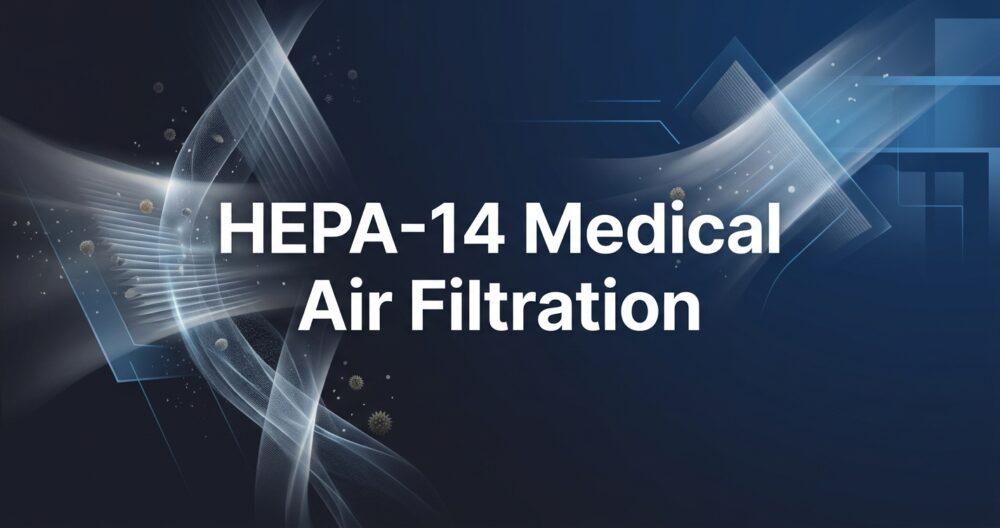
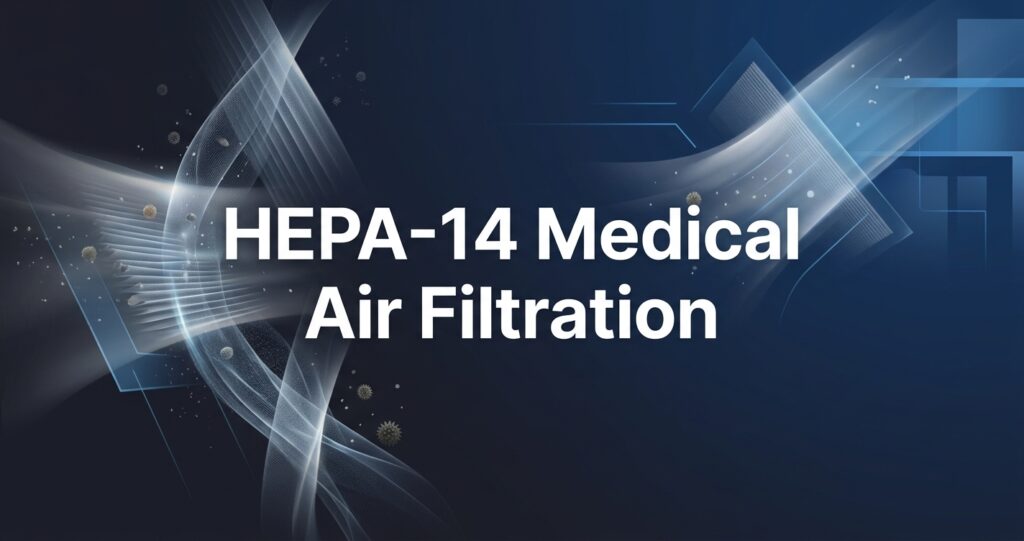
This infographic explains how HEPA-14 and medical-grade filtration help allergy sufferers. It highlights three core benefits: allergen removal, improved indoor air quality, and fewer allergy symptoms.
The Real Cost of HEPA-14 & Medical-Grade Air Filtration for Allergy Sufferers
We want to be completely honest with you about something that most product pages gloss over: the sticker price on an H14 air purifier is just the beginning of the financial picture. Being upfront about ongoing costs is the only fair way to help you make a truly informed decision.
Here is how a typical HEPA-14 unit’s costs break down over five years of ownership:
- Unit purchase price: A quality HEPA-14 unit for allergy sufferers typically costs between $250 and $700 at launch.
- Replacement H14 filters: Genuine replacement filters range from $40 to $120 each, replaced every 6 to 12 months. That is $80 to $240 per year in filter costs alone.
- Electricity: Running a 40W unit 24/7 at average U.S. electricity rates costs approximately $40 to $60 per year.
- Pre-filter replacements: Usually lower cost at $15 to $30 annually.
Over five years, the total cost of ownership for a well-maintained HEPA-14 system often sits between $900 and $1,800 depending on the model and local energy costs.
That is a meaningful investment, but one that our research consistently shows pays back in reduced allergy medication, fewer GP visits, and measurably better sleep quality for most sufferers.
Check Prices and Availability at Amazon
HEPA-14 & Medical-Grade Air Filtration for Allergy Sufferers: Pairing with Your Cleaning Routine
We firmly believe that air filtration and surface cleaning are partners, not alternatives. Running the world’s best HEPA-14 unit in a room that hasn’t been vacuumed in weeks is like using a brilliant shower filter but never scrubbing the shower walls.
Allergens like pet dander and dust mite debris settle onto surfaces and re-enter the air with every step, every sitting-down, every time a pet shakes itself. Your HEPA-14 air purifier then has to work much harder to clean air that’s being continuously refreshed with new particles from the floor and furniture.
A consistent vacuuming routine, ideally with a machine that has a fully sealed filtration system, directly reduces the allergen reservoir in your home that your air purifier has to contend with.
We cover a wide range of vacuum models with strong filtration credentials in our handheld vacuum section, including options specifically suited to allergy-sensitive households.
The combination of a HEPA-14 air purifier running continuously and a sealed-filtration vacuum used regularly is genuinely one of the most effective total allergen management strategies available for home use in 2026.
Conclusion: Is HEPA-14 & Medical-Grade Air Filtration Worth It for Allergy Sufferers?
After everything we’ve walked through in this guide, our answer is a clear and enthusiastic yes, with one important condition: the system has to be the right one, correctly placed, and properly maintained.
HEPA-14 & Medical-Grade Air Filtration for allergy sufferers is not just a marketing upgrade from standard HEPA.
The genuine sealed H14 standard removes allergens at a level previously reserved for hospital environments, and it brings that same protective air quality into your home for a fraction of what chronic allergy treatment costs over time.
The key points to carry forward are these: prioritise your bedroom, match the CADR to your room size, replace filters on schedule, and pair your air purifier with a strong vacuum routine for the most comprehensive protection.
We’re passionate about helping you find the products and strategies that make a real, daily difference in how you feel at home.
Whether you’re exploring medical-grade air filtration options or looking for the perfect vacuum to complement your allergen management setup, our team of dedicated experts is here to walk you through everything with honest, research-backed guidance.
Check Prices and Availability at Amazon
Frequently Asked Questions
Is HEPA-14 air filtration actually worth it for mild allergy sufferers, or is H13 enough in 2026?
For mild or occasional allergy symptoms, a sealed HEPA-13 unit is usually sufficient and will cost less to buy and maintain. HEPA-14 & medical-grade air filtration for allergy sufferers becomes most worthwhile when symptoms are year-round, severe, or involve asthma, since the additional 99.995% capture rate provides meaningful extra protection for the most sensitive users.
What does “medical-grade” mean on an air purifier and how do I verify it?
A genuine medical-grade air purification claim should reference EN 1822 certification and confirm the complete unit (not just the filter media) has been independently tested to H14 standard. Be cautious of any product that only states the filter is “medical-grade” without a whole-unit test certification, as air can bypass even a high-quality filter through an unsealed housing.
How long does it take for a HEPA-14 air purifier to reduce allergy symptoms?
Most allergy sufferers using a properly rated HEPA-14 & medical-grade air filtration system in their bedroom report noticeable symptom improvement within 7 to 14 days of continuous use. Full benefits are typically felt after 4 to 6 weeks when allergen concentrations in the room have been brought to consistently low levels by sustained filtration.
Can I use a HEPA-14 air purifier to help with pet allergies specifically?
Yes, and it is one of the most effective applications. Pet dander particles range from 1 to 10 microns, well within the capture range of H14 filtration, and airborne pet allergens are a primary trigger for many allergy sufferers. Pairing a HEPA-14 unit in the main living area with a vacuum designed for pet hair gives you the most comprehensive protection against pet allergens both in the air and on surfaces.
Do HEPA-14 air purifiers help with dust mite allergies?
HEPA-14 & medical-grade air filtration for allergy sufferers is highly effective at capturing airborne dust mite particles and their waste particles, which are among the most common year-round allergen triggers. However, dust mites live and reproduce in mattresses, pillows, and carpets, so air filtration works best alongside allergen-proof mattress covers, regular hot washing of bedding, and consistent vacuuming of carpeted areas.
How do I know when to replace my HEPA-14 filter?
Most modern HEPA-14 units include a filter replacement indicator light or app notification, and this is the most reliable signal. As a general rule, replace your H14 filter every 6 months in high-use or multi-pet homes, and every 12 months in lower-demand environments. Never attempt to clean or vacuum a used H14 filter, as this can release concentrated trapped allergens directly back into your room.
Are cheap “HEPA-14” air purifiers on budget marketplaces genuinely medical-grade?
Typically no. Many budget products labelled “H14” or “HEPA-14” use filter media that may meet the H14 standard in isolation but are housed in poorly sealed units that allow air to bypass the filter entirely. For genuine HEPA-14 & medical-grade air filtration for allergy sufferers, look for independently verified whole-unit certifications, clear CADR data, and a sealed housing construction confirmed in the product documentation.